
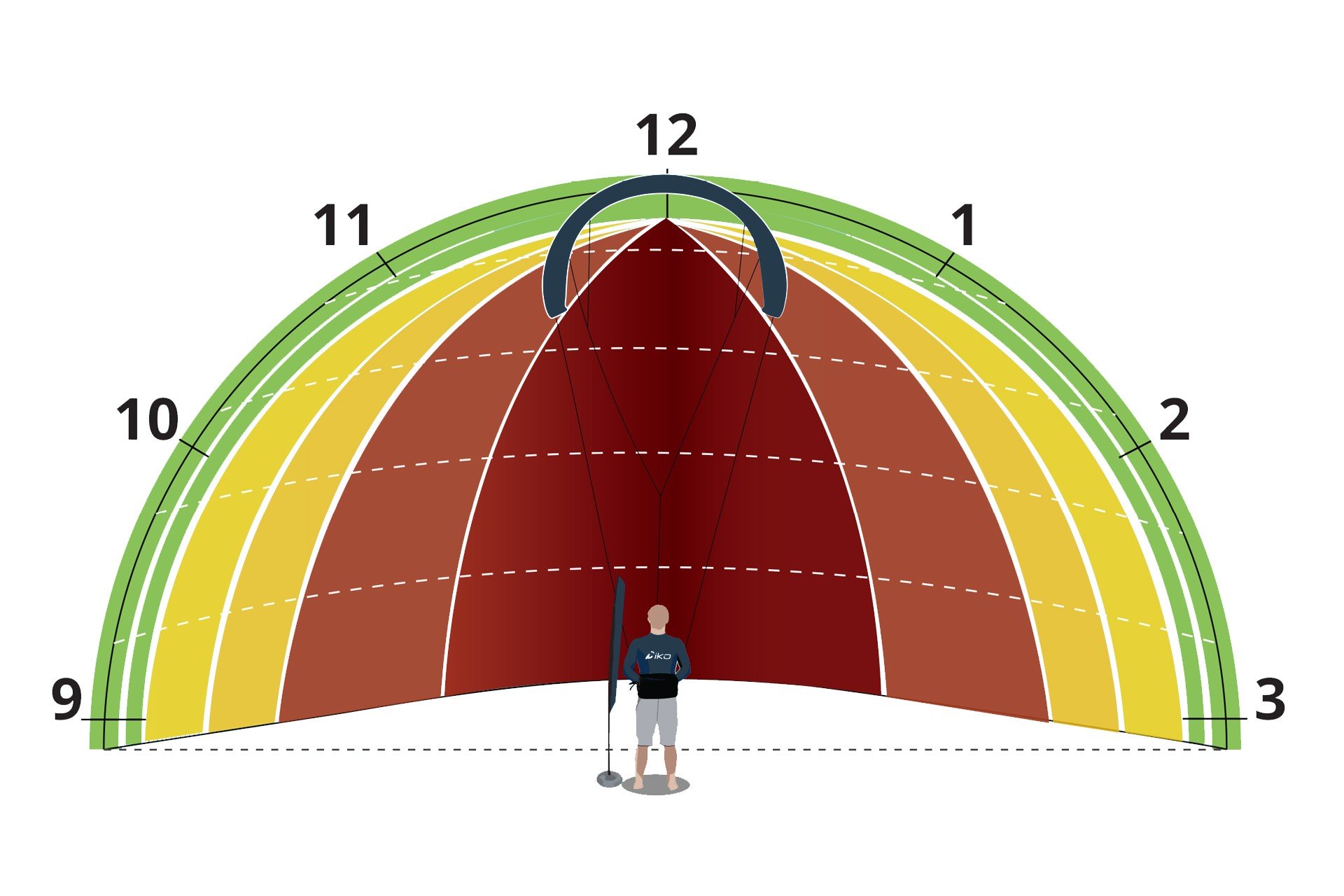
Detailed description of the wind window:
The wind window is a hemisphere located in front of the kiter. This hemisphere is the area where the kite can fly under the wind’s influence. The wind window is divided into several key zones:
- Zenith (12:00) – This is the upper central point of the wind window, positioned directly above the kiter’s head. In this zone, the kite is in a neutral position with minimal pull. The kite rises smoothly here, experiencing the least wind load.
- Edges of the wind window (3:00 and 9:00) – At the sides of the wind window, the kite generates less pull than in the center. When the kite is in these zones, its force is minimal, making them ideal for safe launching and landing.
- Central zone (between 10:00 and 2:00) – This is the most powerful part of the wind window. As the kite moves through the center, it generates maximum pull and speed. In this zone, the kite creates significant force, and its pull increases dramatically.
- Lower zone (5:00 and 7:00) – These zones are located near the ground at the sides of the wind window. Here, the kite can be safely brought to the ground or launched into the air.
- Dead zone (behind the kiter) – In this area, the kite cannot fly as it falls out of the wind’s influence.
Example of kite operation in the wind window:
- For launching: The kite is typically launched from the edge of the wind window because minimal pull is generated here, making the process safer.
- For control: Moving the kite from one part of the wind window to another allows you to control its pull and direction. The closer the kite is to the center of the window, the more force it generates.
- For stopping: To reduce pull or land the kite, it is brought back to the edges of the wind window.
 Snowkiting in Alberta